TRAINING AND SIMULATIONS IN VIRTUAL AND AUGMENTED REALITY

Safe training in high-risk industrial environments

Improving learning through immersive experiences
Reduction in training costs and time
Customized solutions for multiple industrial sectors

VIRTUAL REALITY: VIRTUAL SIMULATION AS A METHOD OF STAFF TRAINING

At TwoReality, we create first-person training experiences and simulations for employees or students, as well as practical and theoretical tests that instructors can assign directly via online streaming.

This approach allows for faster grading while also reducing costs, as users don’t need to travel to the location.

We recreate realistic and interactive 3D industrial environments in virtual reality, where elements respond to the user’s actions.

We recreate industrial environments in virtual reality, such as quarries, refineries, petrochemical facilities, power plants, and other hazardous sites where operators work under risky conditions and must follow established procedures.

This experience is aimed at both facility and machinery manufacturers, as well as engineering companies, and providers of consulting, training, and maintenance services.

MAIN ADVANTAGES OF VIRTUAL REALITY TRAINING:

Reduces the time and cost of training

Facilitates the transfer of know-how

Improve the quality of training

Reduce accidents and injuries during the course

VIRTUAL REALITY: NEW LEARNING TOOLS

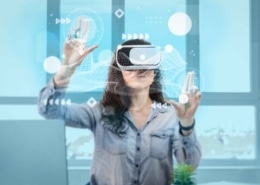
In the industrial sector, Immersive Virtual Reality is a resource that allows for highly effective presentations focused on one or more production plants.

At the same time, the introduction of immersive systems for operating production units and interacting with their components becomes a “game” to experience firsthand.

This way, we gain a much deeper understanding of their technical features and purpose.

Technical information is conveyed through tools designed to enhance understanding by encouraging direct participation from the audience.

Experiencing a 3D environment firsthand allows for a more conscious evaluation of production processes.

TRAINING WITH INTERACTIVE VIRTUAL TOUR

ADVANCED INTERACTIVE VISUALIZATION AND SIMULATION

When aiming to simulate construction processes and real environments, obtain computer-generated reconstructions through appropriate visualization systems, or interact with virtual environments using advanced tools,

it is essential to have highly realistic 3D models.

This way, 3D models can be evaluated more consciously and effectively, even when they involve complex dynamics and environments.

EDUCATIONAL TRAINING IN VIRTUAL REALITY

We develop interactive applications for safety and product training,

as well as industrial environments and systems where instructors can interact with students in real time.

It has been scientifically proven that the human mind learns more effectively when the situations being studied are realistically simulated.

At TwoReality, we build on this simple yet powerful concept to design and deliver innovative virtual and augmented reality solutions,

based on immersive environments and stereoscopic projections.

RESEARCH AND DEVELOPMENT

Human progress and success stories have always gone hand in hand, just as the most innovative inventions have always been born from the ingenuity of researchers.

However, there are times when research requires the most advanced tools to make a leap forward in quality.

Those are the moments when TwoReality can make the difference.

INDUSTRY AND INFRASTRUCTURE IN VIRTUAL REALITY

Both the industrial and infrastructure sectors are governed by complex and demanding safety systems, which must be fully complied with to prevent accidents;

however, there are still significant risks involved in carrying out work related to these divisions, due to the nature of their work.

That is why having highly trained personnel capable of controlling any risky situation and responding to the most serious workplace accidents is essential for these industries.

In this regard, there is no better way to train personnel than through the use of virtual reality,

as it allows them to participate in simulations where workplace and employee safety is compromised, either due to system failures or external factors.

These types of imaginary situations will allow workers to understand the risks of the industry and provide them with the tools and knowledge necessary to deal with similar scenarios in the real world,

educating them on the most effective techniques to solve any problems that may arise.

All this with the advantage of a safe and controlled environment that will allow workers to master their area of training.

FREQUENTLY ASKED QUESTIONS ABOUT VIRTUAL REALITY TRAINING

  • It is a computer-generated simulation in which machines, tools, materials, and participants can be modeled and executed using VR headsets.
  • In augmented reality, virtual elements specifically designed for this purpose are overlaid onto a real space viewed through a mobile device’s camera.
  • In both cases, simulated situations are presented to train learners, allowing the scene to be repeated endlessly without the need for real spaces or machines.
  • The process scenes, machines, and tools are developed exactly as they are used in real life—but without renting spaces or wasting time.
  • It also avoids stopping machinery, wasting materials, or taking up other employees’ time to train apprentices, making them productive much sooner than with traditional training methods.
  • Saves time
  • Can be repeated infinitely
  • Allows the trainer to focus on preparing more material or improving processes
  • Avoids the need to rent spaces
  • Prevents machinery downtime
  • Eliminates the need for nighttime or holiday training sessions
  • Teaches by doing, which increases knowledge retention
  • Teaches safety standards while avoiding risky situations
  • The trainee can experience a simulated accident, preventing damage or even death
  • Definitely yes. When a trainee attends a classroom lesson, they retain about 15% of what they learn. When they watch someone else perform a task, they learn around 30%, and when they learn by doing—even in a simulated environment using VR headsets—they retain more than 50%.
  • They are also allowed to make mistakes on a simulated machine, so they enter the workplace with much more experience than someone who only attended a classroom session.
  • It is useful for any organization that wants to acquire simulator development services and purchase the corresponding VR headsets.
  • It is especially beneficial for companies that spend money annually on classrooms and instructors, have incurred costs from workplace accidents, or dedicate tutor time to supervising trainees.
  • Simulations save time, can be repeated at no additional cost, teach mistakes to avoid, and can simulate accidents to help prevent them in real life.
  • They also allow trainees to become productive in less time and help reinforce knowledge among experienced employees.
  • They provide an innovative technological tool that can be integrated into Industry 4.0 for the maintenance and operation of equipment equipped with IoT sensors.
  • Today, they are understood as branches of Extended Reality and Spatial Computing.
  • Both are developed thanks to technology; however, Virtual Reality is created entirely within a computer-generated environment, while Augmented Reality combines computer-designed elements “projected” into the real environment using a mobile device’s screen.
  • We offer several options depending on the objective, the environment to be developed, and the available budget:
    • Virtual tours to recreate photographed or filmed real spaces, including learning questionnaires
    • Virtual Reality simulations to recreate machinery and production processes
    • Augmented Reality applications to teach step-by-step machinery operation

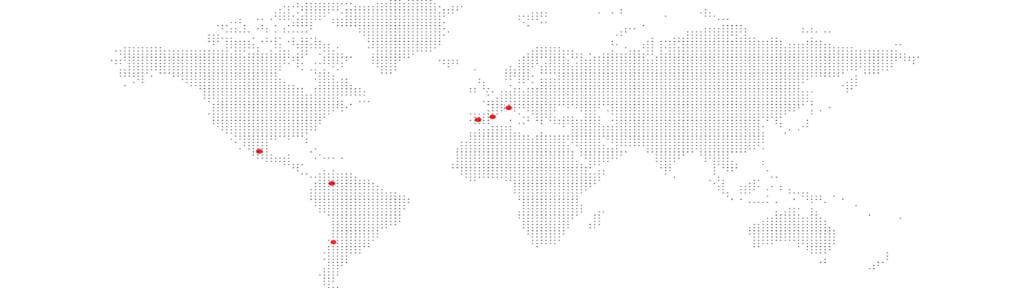
We have been working with VR and AR since 2010, creating content and products for more than 70 multinational, national, Asian, and Latin American companies, with over 100 completed projects and three awards for innovation and quality.

It depends on the content and how close to reality you want it to be. A project is estimated based on the amount of code that needs to be developed, the quantity and quality of 3D modeling, the number of user interactions with the virtual environment, etc.

  • It is useful for developing soft skills such as communication, customer service, teamwork, empathy, problem-solving, creativity, and even for therapeutic treatments to manage phobias.
  • It helps accelerate social inclusion and increase diversity.
  • It strengthens organizational culture and fosters empathy by allowing individuals to virtually step into someone else’s shoes, which helps reduce bias.

Other sectors in which we also work

Real Estate

Museums

Formación y simulaciones

Two Reality in the media

Leave us your phone number and we will call you in less than 24 hours. Tell us what you have in mind and we will contact you.

We are waiting for you!